BNB Chain block time in 2026: 0.45 seconds, and what it means for your swap
BNB Chain now makes a block every 0.45 seconds and finalises in about 1.1. How it got there, how to measure it yourself, and what fast blocks change for quotes.
If you last looked at BNB Chain a couple of years ago, you probably remember 3 second blocks. That number is long gone. Today BNB Smart Chain produces a block roughly every 0.45 seconds, and a block is normally final about 1.1 seconds after it is made. This post walks through how the chain got there, how you can check the numbers yourself, and what such short blocks mean for the price you see when you swap.
From 3 seconds to 0.45 in three hard forks
The block interval came down in three steps, each one a network upgrade defined in a BNB Evolution Proposal (BEP):
| Upgrade | Interval | Mainnet, UTC |
|---|---|---|
| Before Lorentz | 3 s | |
| Lorentz, BEP-520 | 1.5 s | 2025-04-29 |
| Maxwell, BEP-524 | 0.75 s | 2025-06-30 |
| Fermi, BEP-619 | 0.45 s | 2026-01-14 |
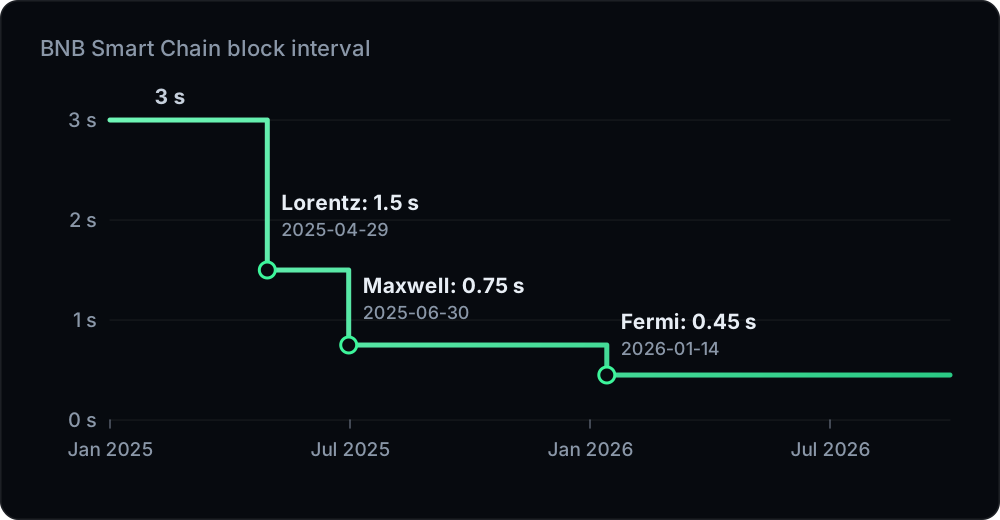
Each step came with matching changes so that the network did not simply produce more of the same blocks. Lorentz, for example, halved the block gas limit from 140 million to 70 million so that overall throughput stayed the same, according to the v1.5.10 release notes. Validators also produce several blocks in a row during their turn. Under Fermi a validator still makes 16 consecutive blocks, which now takes 7.2 seconds.
Two later upgrades, Osaka/Mendel in April 2026 and Pasteur in August 2026, did not change the interval. The BNB Smart Chain introduction in the official docs gives 0.45 seconds as the current block time.
Finality: about 1.1 seconds
A short block time is only half the story. What matters for a trade is when it can no longer be reversed. BNB Smart Chain uses fast finality: validators vote on blocks, and when at least two thirds of them vote normally, a block is final within two blocks. At 0.45 seconds per block that is about 1.125 seconds, as the official docs put it.
For comparison, BNB Chain's 2026 roadmap post says finality went from 7.5 seconds to 1.125 seconds during 2025. If too few validators vote, the chain falls back to slower probabilistic finality, so the 1.1 second figure describes normal operation.
Applications can ask a node for the latest final block directly with the finalized block tag. When we sampled it on 2026-10-01, the finalized block trailed the newest block by one or two blocks each time.
Check it yourself
You do not have to take anyone's word for the block time. Ask any BNB Chain RPC endpoint for the latest block number, wait a minute, and ask again:
curl -s -X POST https://bsc-rpc.publicnode.com \
  -H "Content-Type: application/json" \
  -d '{"jsonrpc":"2.0","id":1,"method":"eth_blockNumber","params":[]}'
The answer is a hex number. Convert both answers to decimal, subtract, and divide by the seconds between them.
We did exactly that on 2026-10-01 and counted 137 blocks in 61.65 seconds of block time, which is 0.450 seconds per block, or 2.22 blocks per second. Over the 24 hours before that, the chain produced 192,000 blocks in 86,429.55 seconds, an average of 0.45015 seconds.
One detail if you use block timestamps for this: the timestamp field still counts whole seconds, so consecutive blocks often share the same value. Since Lorentz, BEP-520 stores the milliseconds in the last two bytes of the header's mixHash. Combine the two for precise timing, or simply count blocks over a long window as we did above.
Gas got cheap as well
Faster blocks arrived together with lower fees. BNB Chain says the gas price fell from 1 gwei to 0.05 gwei during 2025, and by October 2025 all validators and builders had adopted 0.05 gwei as the new minimum, according to its weekly report. The BSC overview in the docs puts a typical transaction at around $0.005 or less.
For a sense of scale: a 1 BNB to USDT swap we quoted on 2026-10-01 estimated 264,165 gas. At 0.05 gwei that is 0.0000132 BNB, about one cent.
What fast blocks mean for your quote
A swap quote is a snapshot of pool balances at one block. With blocks every 0.45 seconds, that snapshot ages quickly in block terms, even if it feels instant to you.
- Ten seconds of reading is about 22 blocks. Every one of them can contain trades in the pools your route uses. That is why a quote can change while you look at it, and why a good interface refreshes it.
- Your wallet is the slowest step. Checking the details and confirming in your wallet usually takes longer than the chain needs to include the transaction. The price you signed for is from a block that may be dozens of blocks old by the time your transaction is mined.
- Slippage tolerance still matters. Fast blocks shorten the gap between quote and inclusion. They do not close it. Your minimum received is what protects you if the price moves in the meantime.
- Deadlines are measured in seconds, not blocks. A deadline of 20 minutes, which is what the Tirio app writes into each quote, covers roughly 2,700 blocks at today's pace.
On tirio.io, the price you see while typing refreshes every 15 seconds and the quote you sign is simulated as the full transaction against the latest block before it reaches you. If the fresh quote is worse than the price you were shown by more than half your slippage tolerance (and never by more than 0.5 %), the app asks you to accept the new price before it lets you swap. Fast blocks make that kind of check more useful, not less.
For developers
If you build on BNB Chain, the Fermi announcement asks teams that rely on polling or fixed timing assumptions to review their event handling and confirmation logic. In practice:
- Do not key anything on
block.timestampalone. Several blocks can share the same second. - Poll by block number or subscribe rather than assuming a block every few seconds.
- Use the
finalizedtag when you need certainty rather than counting a fixed number of confirmations from older habits. - Budget for more blocks per minute in indexers and log queries. A one-hour window is now about 8,000 blocks.
Short blocks change the feel of the chain more than any single feature. Prices update more often, finality arrives in about a second, and the slowest part of a swap is now the person holding the wallet. If you want to see how that plays into the numbers on a real quote, our guide to reading a swap quote walks through one line by line.